Zhejiang NENA Electric Co., Ltd. — Technical Research Department
Abstract
The bypass contactor is an indispensable and critical component within industrial motor soft-starting systems. Once the motor accelerates to its rated speed, the bypass contactor closes, connecting the power supply directly to the motor. This action removes the SCRs (Silicon Controlled Rectifiers) from the main circuit, thereby eliminating the continuous conduction losses associated with solid-state components, reducing thermal stress, and extending the equipment's service life. Based on how the bypass contactor is integrated with the soft starter, the market primarily offers two distinct solutions: Built-in Bypass (Integrated) and External Bypass. This paper systematically analyzes the technical differences between these two approaches across various dimensions—including operating principles, structural characteristics, heat dissipation, system reliability, maintainability, and typical application scenarios. Furthermore, it provides engineering selection recommendations aimed at assisting engineers and procurement decision-makers in selecting the soft-starting solution best suited to their specific operating conditions.
Keywords: Soft Starter; Bypass Contactor; Built-in Bypass; External Bypass; SCR; Motor Control; Industrial Automation
Introduction
In modern industrial production, a vast array of equipment—including pumps, fans, compressors, conveyors, and mining machinery—relies on three-phase AC asynchronous motors for propulsion. While Direct-On-Line (DOL) starting is a simple method, it generates high inrush currents—reaching 6 to 8 times the rated current—which inflict severe stress on the power grid, mechanical transmission systems, and motor insulation, thereby shortening equipment lifespan. The soft starter addresses this issue by utilizing SCRs (Silicon Controlled Rectifiers) to implement ramp control of the motor terminal voltage, thereby achieving smooth starting and soft stopping. Consequently, it stands as one of the most prevalent motor starting solutions currently employed in the industrial sector.
However, if the SCRs within the soft starter remain in the main circuit and continue to conduct current during the motor's full-speed operation phase, they generate a conduction voltage drop of approximately 1.5 to 2 volts per phase. This phenomenon results in additional conduction losses and thermal accumulation—an issue that becomes particularly pronounced in high-power applications. The introduction of the bypass contactor is specifically designed to address this issue: once the motor reaches its rated speed, the bypass contactor connects the motor directly to the power grid, thereby disengaging the soft starter's SCRs from the main power circuit and restoring the system to high-efficiency operation.
The integrated form of the bypass solution directly impacts the system's physical footprint, cost, thermal management, reliability, and maintainability. This article will provide an in-depth analysis of the technical characteristics and differences between two typical solutions—integrated bypass and external bypass—offering a systematic reference for engineering selection.
Working Mechanism and Necessity of the Bypass Contactor
2.1 Analysis of SCR Conduction Losses
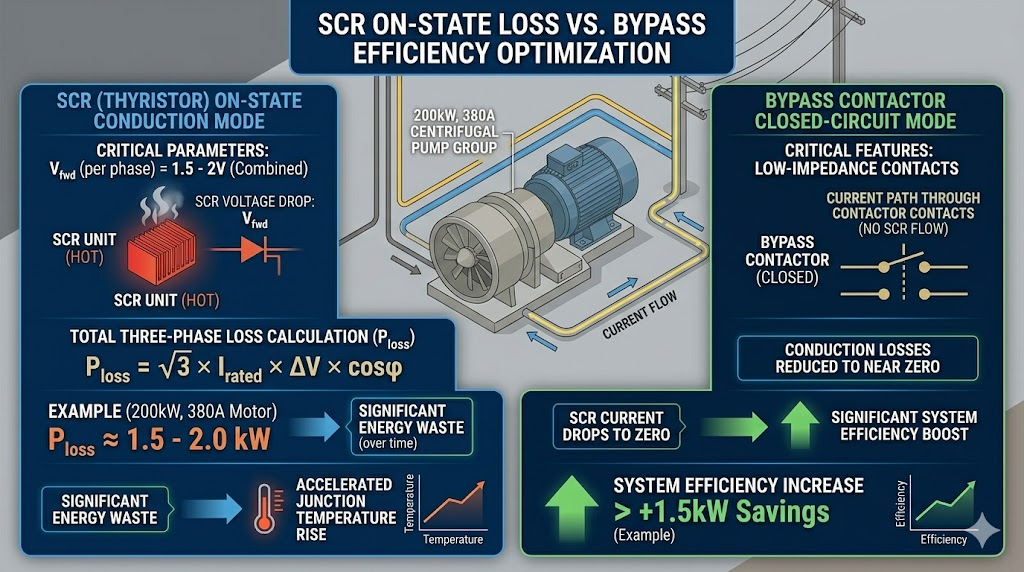
When in the conducting state, SCRs (Silicon Controlled Rectifiers) exhibit an inherent forward voltage drop (typically 1.0–1.8 V per device; approximately 1.5–2 V per phase for a bidirectional SCR pair). Under continuous operation conditions for high-power motors, the total three-phase power loss can be calculated as follows:
P_loss = √3 × I_rated × ΔV × cosφ
Taking a motor with a rated power of 200 kW and a rated current of 380 A as an example, the SCR conduction loss amounts to approximately 1.5–2 kW. Prolonged operation under these conditions results in significant energy waste and accelerates the rise of the SCR junction temperature. Once the bypass contactor closes, the main circuit current is carried entirely by low-impedance metal contacts; the SCRs no longer carry the load current, and their conduction losses drop to nearly zero, resulting in a significant improvement in system efficiency.
2.2 Bypass Contactor Operating Sequence
The standard bypass sequence consists of the following four stages:
- Startup Phase: The soft starter controls the SCRs to gradually increase the voltage at the motor terminals, limiting the starting current and allowing the motor to accelerate smoothly.
- Bypass Triggering: When the motor speed approaches its rated value (typically 90%–98% of the rated speed), the soft starter outputs a bypass signal, actuating the bypass contactor to close.
- Full-Speed Operation: The bypass contactor contacts conduct, connecting the motor directly to the power grid; the SCRs disengage from the main circuit, and the soft starter enters a standby mode.
- Shutdown Phase: Upon receipt of a stop command, the bypass contactor opens, and the SCRs re-engage to execute a soft-stop or braking sequence.
Soft Starters with Built-in Bypass
3.1 Structural Principle
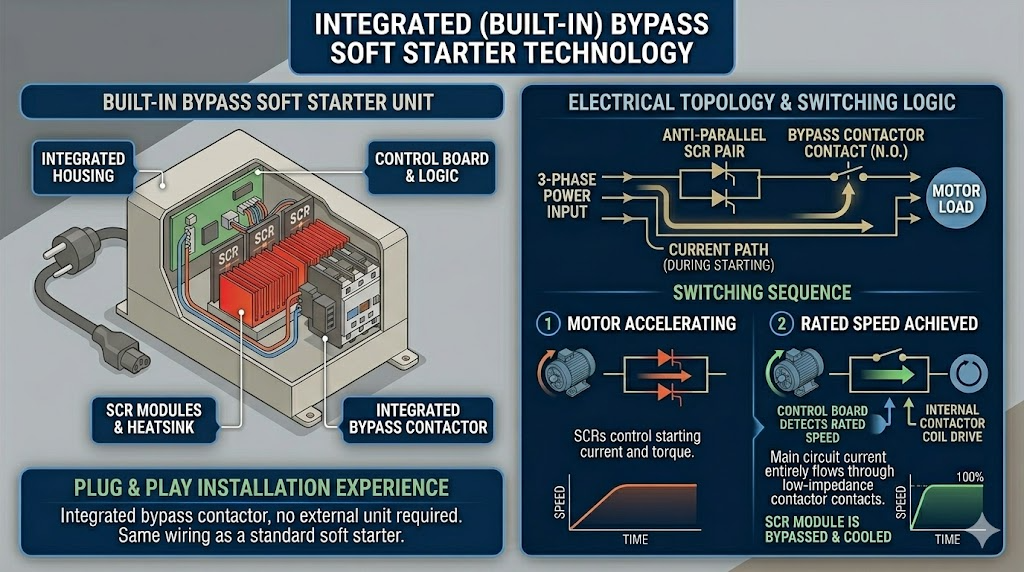
A soft starter with a built-in bypass integrates the bypass contactor directly into the device's housing. Together with the SCR modules, control circuitry, and heat dissipation system, it forms a single, unified unit. Users do not need to procure or configure a separate bypass contactor; the wiring remains identical to that of a standard soft starter, offering a true "out-of-the-box" installation experience.
In terms of electrical topology, the built-in bypass contactor is connected in parallel with the three pairs of anti-parallel SCRs within the same power circuit. Once the control board detects that the motor has reached its rated speed, it energizes the built-in contactor coil; the contactor's contacts then bridge the SCRs, thereby completing the bypass switching process.
3.2 Technical Advantages
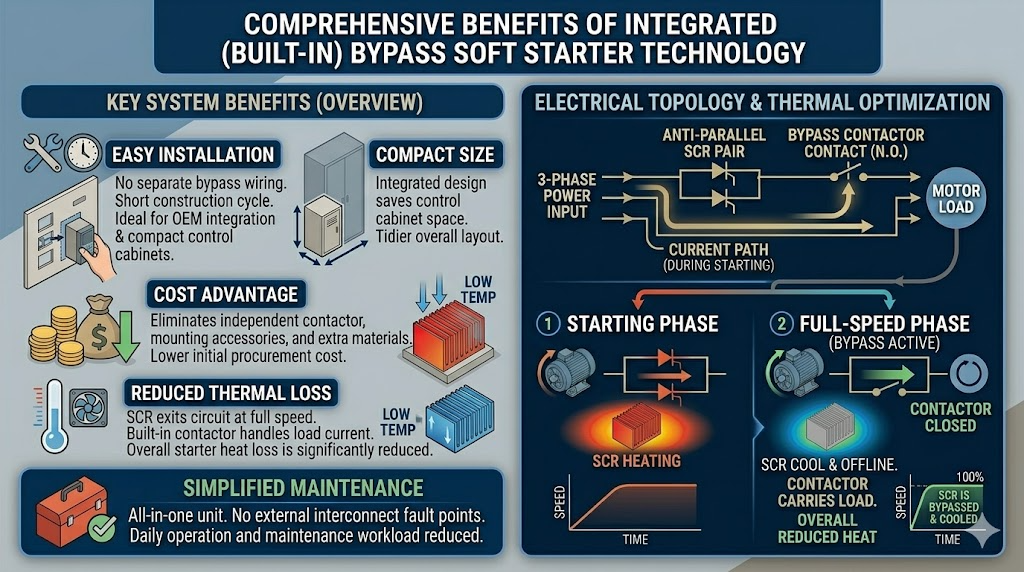
- Simplified Installation: Eliminates the need for separate wiring for a bypass contactor, resulting in shorter installation times. This is particularly advantageous for OEM equipment integration and applications where control cabinet space is at a premium.
- Compact Footprint: The integrated design conserves installation space within the control cabinet, resulting in a cleaner and more organized overall layout.
- Cost Efficiency: By eliminating the need for a standalone contactor, mounting accessories, and additional wiring materials, the initial procurement cost is significantly reduced.
- Optimized Thermal Management: Once full speed is reached, the SCRs are taken out of the circuit, and the built-in contactor assumes the full load current; this results in a substantial reduction in the overall thermal dissipation requirements of the soft starter unit.
- Simplified Maintenance: As a fully integrated unit, there are no external interconnection points that could serve as potential failure sources, thereby minimizing the workload associated with routine operation and maintenance.
3.3 Technical Limitations
- Power Ceiling: The contact capacity of the built-in contactor is typically designed for motor power ratings below 200 kW, limiting the selection options for ultra-high-power applications.
- High Repair Costs: If the built-in contactor fails, the entire unit typically requires return-to-factory service or replacement of the main soft starter body, resulting in relatively high repair costs.
- Thermal Design Constraints: The built-in contactor shares the heat dissipation structure with the SCRs, making the thermal design significantly more complex—particularly in applications involving frequent start-stop cycles.
- Limited Customization Flexibility: The specifications of the contactor are fixed by the manufacturer; users are unable to independently select or upgrade to higher-specification contactors to suit specific operational conditions.
External Bypass Soft Starter
4.1 Structural Principle
In the External Bypass Soft Starter configuration, the soft starter unit itself does not contain a bypass contactor; instead, the bypass contactor is installed as a separate device within the control cabinet and connected to the soft starter's bypass output terminals via external wiring. Upon detecting a "full speed" signal, the soft starter energizes the external contactor coil—either through auxiliary contacts or a relay signal—to execute the bypass switching operation.
The external bypass configuration grants system engineers complete freedom in component selection: they can independently select the most suitable contactor model—in terms of rated current, durability class, and IP protection rating—based on factors such as motor power, start-stop frequency, and environmental conditions. Furthermore, they can even configure redundant bypass circuits to satisfy the extremely high reliability requirements of critical industrial processes.
4.2 Technical Advantages
- Full-Rated Contactors: Allows for the selection of industrial-grade contactors that fully meet the motor's power requirements; voltage withstand, current capacity, and mechanical lifespan are precisely matched to the actual load, unconstrained by the physical dimensions of the soft starter enclosure.
- High-Power Adaptability: Suitable for motors ranging from several hundred kilowatts up to several megawatts, and widely deployed in heavy industrial sectors such as mining, petrochemicals, and metallurgy.
- Modular Maintenance: The contactor and soft starter operate independently of one another; should either component fail, it can be replaced individually, thereby significantly reducing maintenance downtime and spare parts costs.
- Redundancy Design Capability: Through the use of dual bypass contactors or specific bypass switching logic, the system can be configured to allow the bypass contactor to sustain motor operation in the event of a soft starter failure, thereby enhancing overall system availability.
- Enhanced Diagnostic Capabilities: During full-speed motor operation, the external bypass configuration facilitates more comprehensive monitoring of electrical parameters within the main power circuit, thereby supporting effective preventive maintenance strategies.
- Adaptability to Harsh Environments: The external contactor can be selected with an appropriate IP protection rating (e.g., IP54, IP65) to meet specific site requirements regarding explosion protection, corrosion resistance, high-temperature tolerance, and other environmental challenges.
4.3 Technical Limitations
- High Installation Complexity: Requires additional mounting space for contactors, control cabling, and wiring labor, thereby increasing the difficulty of system integration.
- Significant Space Requirement: The control cabinet must allocate dedicated mounting space for independent contactors, imposing stricter requirements on the overall layout.
- Increased Initial Cost: When factoring in the combined costs of bypass contactors, mounting brackets, auxiliary control wiring materials, and commissioning fees, the upfront investment exceeds that of solutions with built-in bypass functionality.
- Stringent System Commissioning Requirements: The timing of the external bypass must be precisely synchronized with the control logic of the soft starter; commissioning errors may result in switching transients or system malfunctions.
Comprehensive Comparison of the Two Solutions
The table below provides a systematic, multi-dimensional comparison between soft starters with built-in bypasses and those with external bypasses:
|
Comparison Dimension
|
Soft Starter with Built-in Bypass
|
Soft Starter with External Bypass
|
|
Bypass Contactor Location
|
Integrated within the soft starter unit
|
Independently installed external to the soft starter
|
|
Installation Method
|
Plug-and-play; simple wiring
|
Requires additional wiring and configuration; installation is more complex
|
|
Space Footprint
|
Compact; small physical volume
|
Requires reserved space for the external contactor
|
|
Applicable Power Range
|
Small to medium-sized motors (≤ 200 kW)
|
Large and heavy-duty motors (> 200 kW)
|
|
Heat Dissipation
|
Bypass engages after startup, bypassing SCRs; low heat generation
|
SCRs are completely removed from the circuit; superior heat dissipation performance
|
|
System Flexibility
|
Limited scope for customization
|
Contactor or soft starter can be independently replaced or upgraded
|
|
Ease of Maintenance
|
Integrated maintenance; individual components cannot be replaced separately
|
Modular maintenance; faulty components can be replaced individually
|
|
Initial Cost
|
Lower (integrated solution) | Higher (increased costs for accessories and installation)
|
Higher (increased costs for accessories and installation)
|
|
Diagnostic Capabilitie
|
Reliability Redundancy
|
Redundant circuits can be designed for enhanced reliability in critical applications
|
|
Typical Application Scenarios
|
Unified diagnostics via the soft starter unit
|
Provides more comprehensive electrical diagnostics when operating at full speed
|
|
Comparison Dimension
|
Pumps, fans, light-duty conveyors
|
Mining, oil & gas, metallurgy, heavy-duty compressors
|
Selection Decision Framework
When choosing between these two solutions, engineers are advised to conduct a comprehensive evaluation based on the following dimensions:
6.1 Based on Motor Power Rating
Generally, for motors with a rated power of 200 kW or less, the built-in bypass solution is the preferred choice, balancing both cost-effectiveness and ease of installation. For large motors exceeding 200 kW, the external bypass solution is recommended to ensure adequate contactor capacity and provide a sufficient thermal margin for heat dissipation.
6.2 Based on Operational Continuity Requirements
For critical equipment requiring continuous, round-the-clock operation (such as municipal water supply pumping stations, chemical circulation pumps, or main mine ventilation fans)—where system downtime incurs extremely high costs—the external bypass solution should be prioritized. Furthermore, redundant control strategies should be implemented to maximize system availability.
6.3 Based on Installation Constraints
For OEM equipment, mobile work platforms, or distributed pumping stations where control cabinet space is extremely limited, an integrated bypass solution can significantly simplify system integration tasks and shorten the engineering cycle. Conversely, for fixed-installation environments—where space is ample and professional maintenance is readily available—an external bypass offers greater flexibility.
6.4 Centered on Life Cycle Cost (LCC)
When evaluating and selecting equipment, one should not be limited solely to the initial purchase price. Instead, installation and commissioning costs, spare parts expenses, losses incurred from maintenance-related downtime, and differences in energy efficiency should all be incorporated into a comprehensive Life Cycle Cost (LCC) analysis framework. For scenarios involving long-term, heavy-load operation, the maintenance flexibility and reliability advantages of an external bypass often translate into higher overall returns during the operational phase.
Reference Cases for Engineering Practice
7.1 Case Study 1: Municipal Sewage Treatment Pumping Station (Integrated Bypass)
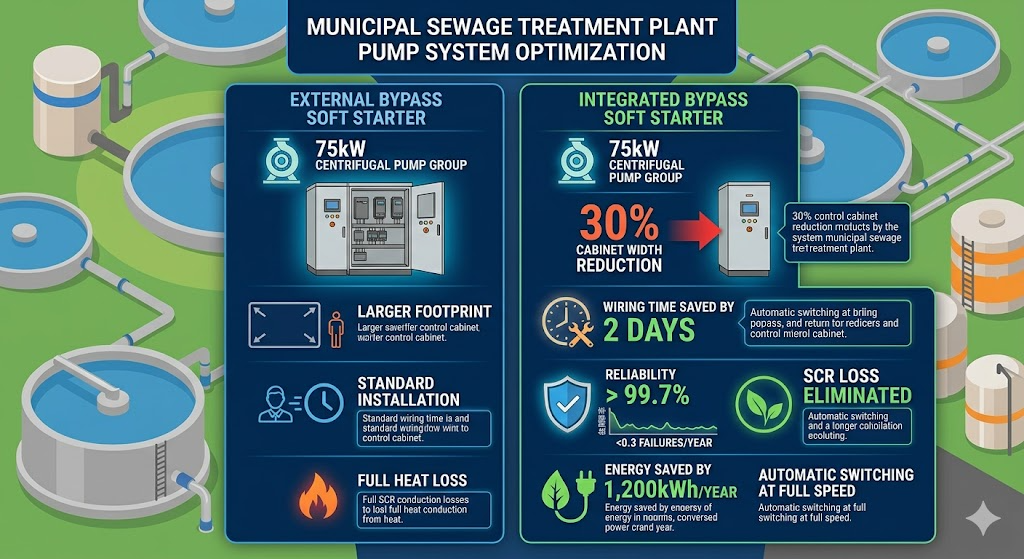
A municipal sewage treatment plant utilizes a centrifugal pump group with a power rating of 75 kW. The control cabinet is installed within an outdoor prefabricated enclosure where space is limited. By selecting a soft starter with an integrated bypass, the width of the control cabinet was reduced by approximately 30% compared to an external bypass solution. Furthermore, the time required for on-site wiring was shortened by two days. Over three years of operation, the cumulative fault rate has remained below 0.3 incidents per year. The integrated bypass automatically switches over once the motor reaches full speed; this completely eliminates SCR conduction losses, resulting in average annual electricity savings of approximately 1,200 kWh.
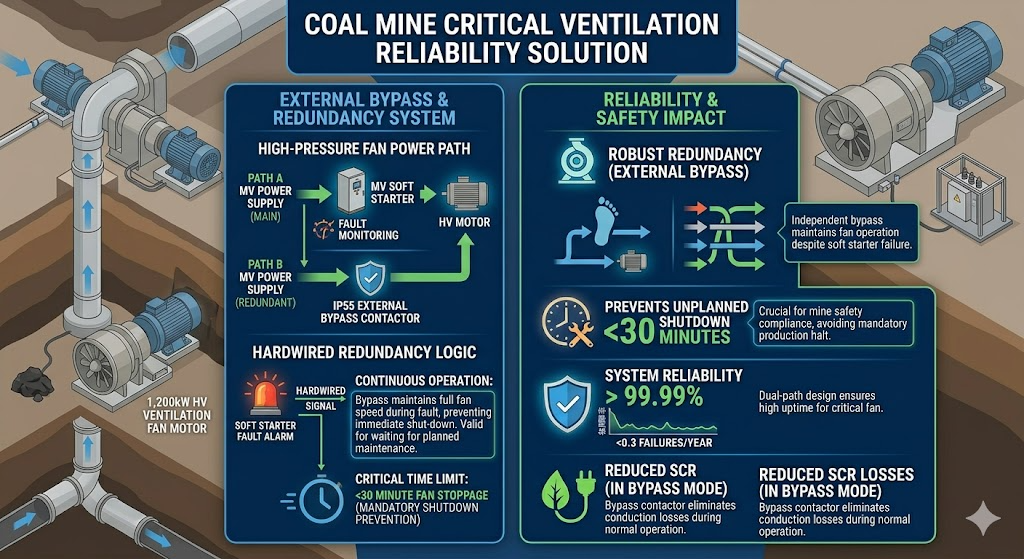
7.2 Case Study 2: Main Mine Exhaust Fan (External Bypass)
The main exhaust fan within a coal mine's ventilation system is driven by a 1,200 kW high-voltage motor. This application demands an extremely high level of power supply continuity—specifically, if the fan ceases operation for more than 30 minutes, it triggers a mandatory production shutdown procedure in accordance with mine safety regulations. The system design employs an external bypass solution, utilizing an industrial-grade bypass contactor with an IP55 protection rating. Additionally, a redundant bypass circuit was implemented: should the soft starter trigger a fault alarm, the external bypass contactor can—via hardwired logic—independently maintain the fan's operation, thereby allowing the system to await a scheduled maintenance shutdown and effectively mitigating the risk of unplanned production stoppages.
Introduction to Zhejiang
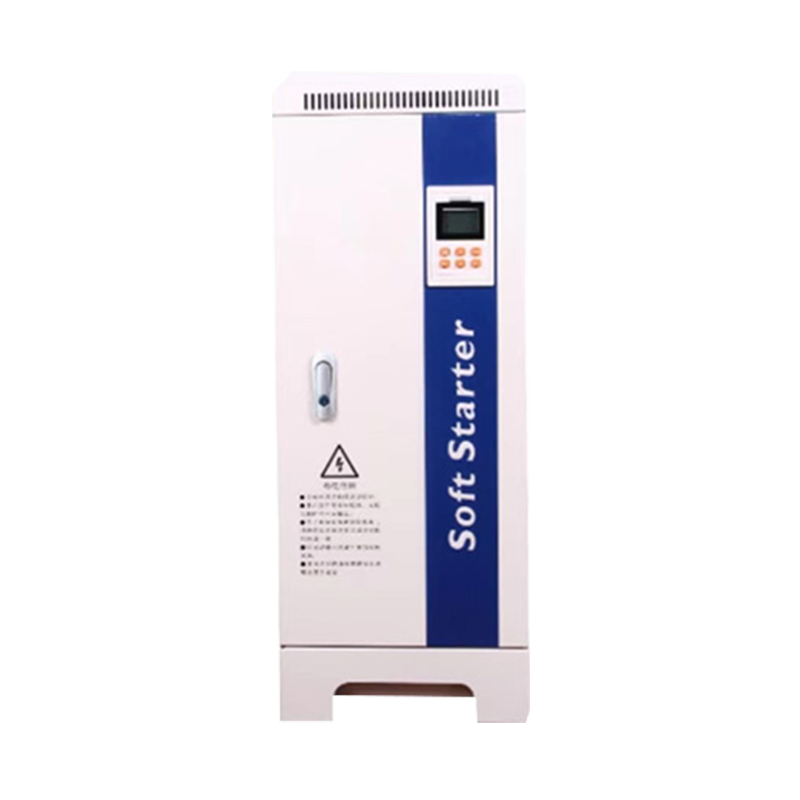
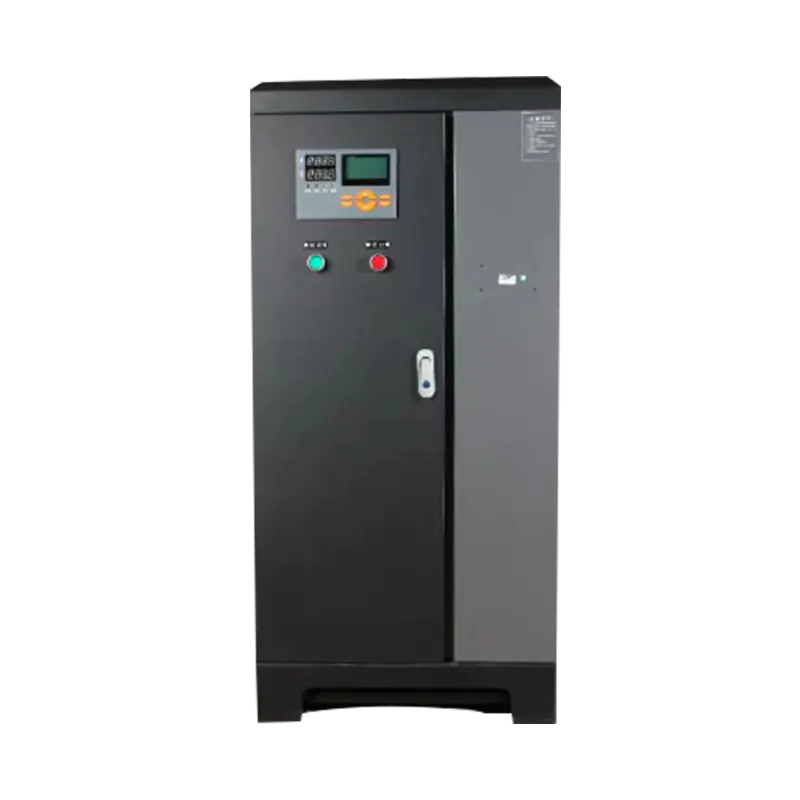
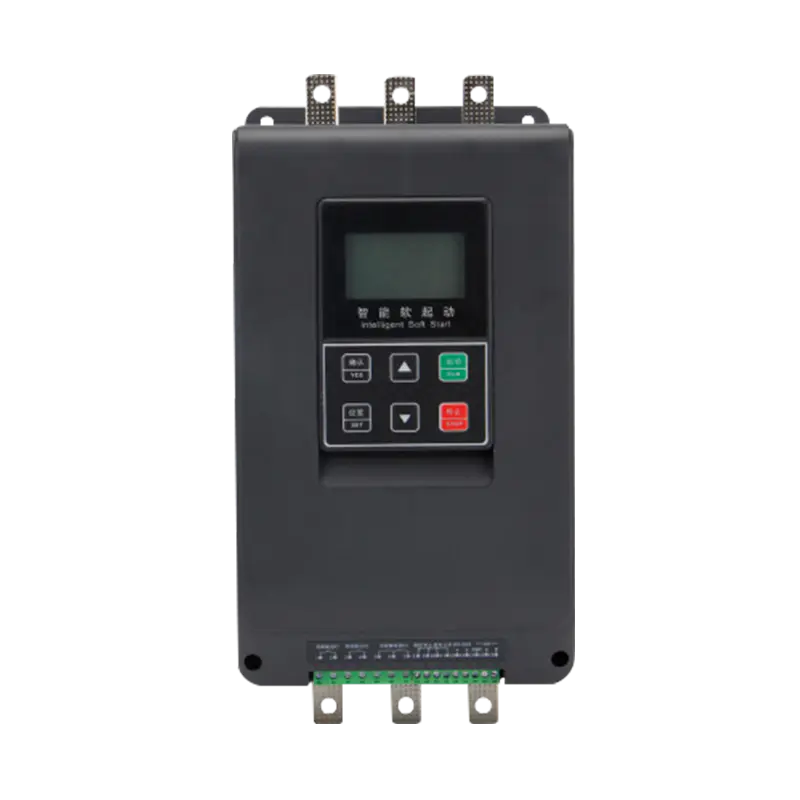
Introduction to Zhejiang Xinhang Electric's Soft Starter Product Series
Zhejiang NENA Electric Co., Ltd. specializes in the R&D and manufacturing of power electronics and industrial automation control products. Its soft starter product portfolio encompasses two primary technical approaches—built-in bypass and external bypass—catering to application requirements across the entire power spectrum, ranging from light-duty pumps to large-scale heavy industrial motors.
8.1 Built-in Bypass Series
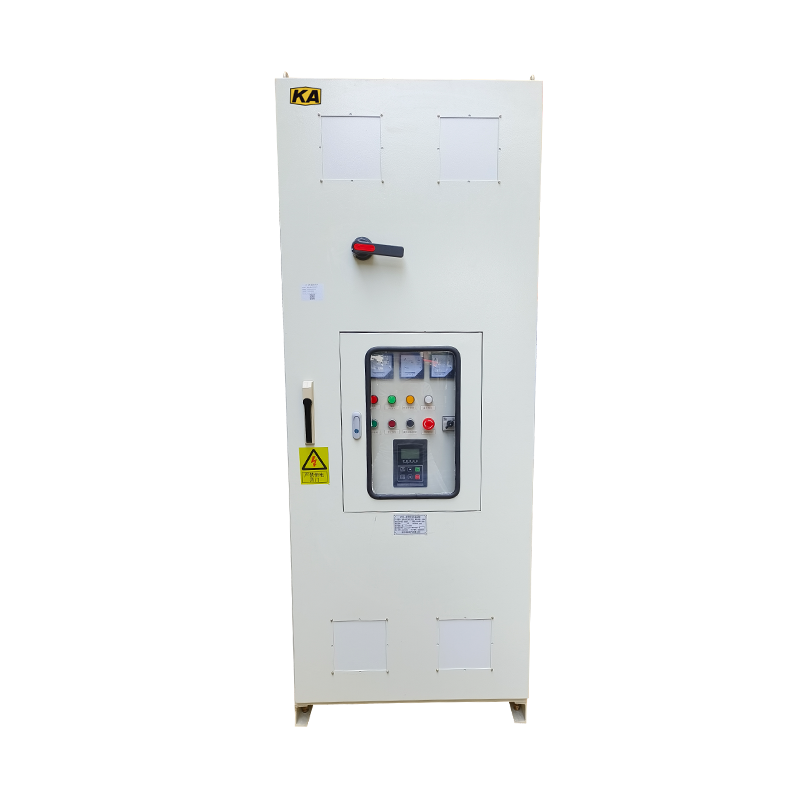
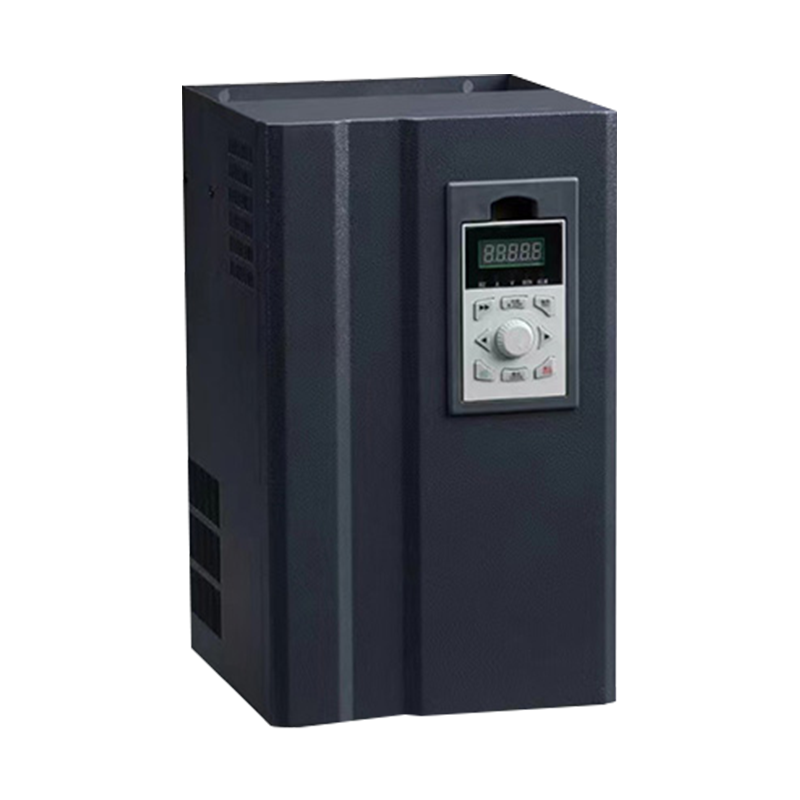
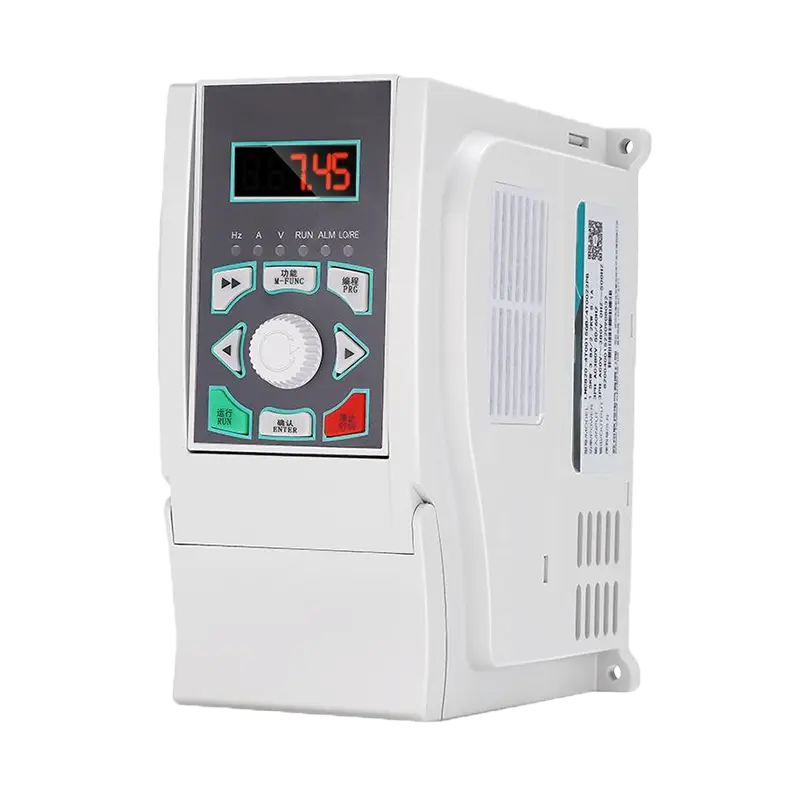
The company's built-in bypass soft starters integrate highly reliable contactors featuring silver alloy contacts. With start-up sequence control precision accurate to the millisecond level, these units are ideally suited for pumps, fans, and light-duty conveying equipment subject to frequent start-stop cycles. The products hold international certifications such as CE and CCC, support RS485/Modbus RTU communication protocols, and can be seamlessly integrated into SCADA systems.
8.2 External Bypass Series
For high-power motors and critical process applications, the company offers comprehensive external bypass soft starter solutions. These solutions include dedicated bypass control modules and detailed wiring guidelines, ensuring precise synchronization between the bypass timing and the soft starter's control logic. Our engineering team is available to provide customized wiring schemes and on-site commissioning support services.
Conclusion
Both built-in and external bypass soft starters share the core objectives of enhancing system energy efficiency and safeguarding motor operation. However, they differ fundamentally in the method by which the bypass contactor is integrated; this distinction gives rise to differentiated characteristics across multiple dimensions, including physical size, cost, flexibility, and reliability.
With their compact structure, simplified installation, and lower initial cost, built-in bypass soft starters offer distinct advantages in small-to-medium power applications, space-constrained environments, and standardized operational scenarios. Conversely, external bypass soft starters—characterized by full-rated contactor capacity, modular maintenance capabilities, and flexible redundant designs—demonstrate irreplaceable engineering value in high-power applications, environments with stringent reliability requirements, and complex operating conditions.
When making product selection decisions, engineers should comprehensively evaluate factors such as motor power ratings, continuous operation requirements, installation conditions, available maintenance resources, and total lifecycle costs, rather than focusing solely on product pricing. Zhejiang NENA Electric is committed to providing every client with robust, technically sound soft starter system solutions that offer the optimal fit for their specific needs. We invite you to contact our engineering and technical team for expert assistance with product selection.
References
[1] Bill Bernhardt, Rockwell Automation. "To Bypass or Not To Bypass? Is That the Question?" Rockwell Automation Blog, 2016.
[2] XICHI Electric. "Bypass Contactor and Motor Soft Starter: A Perfect Duo for Efficiency." XICHI Technical Blog, 2024.
[3] IEC 60947-4-2: Low-voltage switchgear and controlgear – Part 4-2: Contactors and motor-starters – AC semiconductor motor controllers and starters.
[4] GB/T 21711.4-2008, *Electromechanical Elementary Relays – Part 4: Contact Parameters*, and related national standards for industrial soft starters.
[5] Rockwell Automation. "Soft Starter Bypass Technology in Smart Motor Controllers." White Paper 150-WP006, 2016.



 English
 中文简体
中文简体 عربى
عربى




 浙公网安备33038202003754号