Soft Starter Motor Compatibility
Key Elements and Engineering Practices in Motor Parameter Matching for Soft Starter Selection
Introduction: The Neglected "Compatibility" Issue
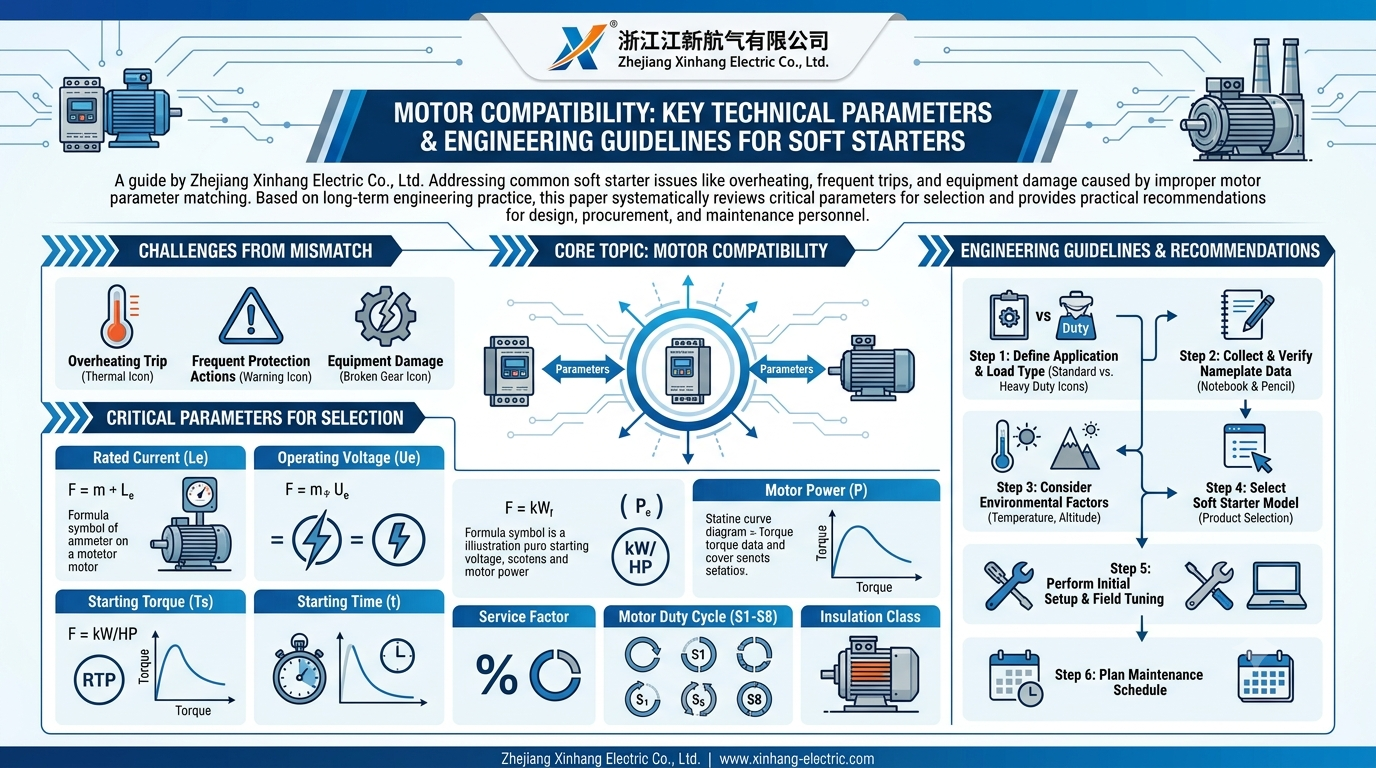
A soft starter is one of the most widely used reduced-voltage starting devices in the field of industrial motor control. Its core value lies in smoothly and controllably regulating voltage or current, thereby reducing the impact on the power grid, the mechanical transmission system, and the driven load during motor starting. However, in actual engineering selection, many users tend to simplify the selection of a soft starter as a "power-to-power" correspondence – that is, believing that as long as the rated power of the soft starter matches the motor power, it can be put into use. This understanding neglects the systematic matching issues between the motor and the soft starter in multiple dimensions, including rated current, voltage level, starting torque characteristics, permissible starting frequency, and even operating environment adaptability. These are precisely the key factors that determine whether the soft starter can operate stably and reliably.
As an enterprise specializing in the R&D, production, and manufacturing of motor control and industrial automation products, Zhejiang Xinhang Electric Co., Ltd. has found through long-term engineering practice and customer service that problems such as soft starter overheating tripping, frequent protection actuation, and even equipment damage caused by improper motor parameter matching are not uncommon. This article will focus on the core topic of "soft starter motor compatibility" (Motor Compatibility), systematically sort out the key technical parameters that need to be verified during the selection process, and propose actionable recommendations based on engineering practice, for the reference of technical personnel engaged in the design, procurement, and maintenance of motor control systems.

Basic Working Principle of the Soft Starter
To understand why "parameter matching" is important, it is first necessary to understand the basic working mechanism of the soft starter. Currently, mainstream solid-state soft starters typically adopt an anti-parallel thyristor (SCR, silicon controlled rectifier) structure, connected in series between the power supply and the motor stator windings, and control the amplitude of the voltage applied to the motor terminals through phase-shift triggering. During the starting phase, the controller follows a preset voltage ramp-up curve or current limit curve, gradually increasing the voltage applied to the motor from low to high, so that the motor speed rises smoothly, avoiding step-type abrupt changes in current and torque.
Taking a typical NEMA B class induction motor as an example, if the traditional full-voltage direct-on-line starting method is used, the starting current can reach 6 to 8 times the rated current at the moment of starting. The resulting impact may not only cause power grid voltage fluctuations, lighting flicker, and even maloperation of protection devices, but also impose large instantaneous stress on mechanical components such as couplings, gearboxes, and belt drives. After control via a soft starter, the starting current can usually be limited to about 2 to 4 times the rated current (the specific multiple can be set according to the load characteristics), and the starting torque also changes smoothly, thereby significantly reducing the dual impact on both the electrical and mechanical systems. Because the control logic of the soft starter is designed based on the electrical and mechanical characteristics of the motor, its selection must naturally be based on accurate knowledge of the motor parameters.
Motor Parameter Matching: Core Elements of Soft Starter Selection
The compatibility between the soft starter and the motor is not determined by a single parameter, but constitutes a systematic matching relationship composed of the following several parameters.
1. Rated Current and Locked Rotor Current: Primary Prerequisite for Capacity Matching
The full load amps (FLA) marked on the motor nameplate is the basic basis for soft starter selection. The rated output current of the soft starter must not be lower than the motor's full load current, and it is common industry practice to reserve a margin of 10% to 20% to cope with load fluctuations, grid voltage deviations, or additional current demands from future process adjustments. At the same time, the motor's locked rotor amps (LRA) and locked rotor current multiple should also be checked to confirm that the soft starter's current limiting range can cover this value – most solid-state soft starters have an adjustable current limit range between 2 and 5 times the rated current. If the motor's locked rotor current multiple exceeds the adjustable range of the soft starter, it will result in insufficient starting torque, failure of the motor to accelerate properly, or even locked-rotor burnout.
2. Rated Voltage and Number of Phases: Consistency of Electrical Ratings
The input voltage level of the soft starter (e.g., 380V, 400V, 415V, 690V, etc.) must be consistent with the motor's rated voltage and the on-site grid voltage. Mismatch in voltage level will not only cause the soft starter to fail to operate normally, but in severe cases may also cause motor insulation damage or overvoltage breakdown of the soft starter's internal power devices. For industrial sites with large voltage fluctuations, attention should also be paid to the allowable input voltage fluctuation range of the soft starter, to avoid nuisance protection or device damage due to undervoltage or overvoltage.
3. Motor Type and Winding Configuration
Standard solid-state soft starters are mainly suitable for three-phase squirrel-cage induction motors (AC Induction Motor), which is also the most common motor type in industrial applications due to its simple structure, ruggedness, and high reliability. If the driven motor is a wound-rotor motor or a synchronous motor, a dedicated soft starter model with corresponding control functions must be selected; otherwise, compatibility issues such as loss of excitation control or lack of rotor circuit protection may occur. In addition, for special configurations such as two-speed motors or multi-winding motors, the adaptability of the control logic should be confirmed with the soft starter supplier during the selection stage.
4. Load Torque Characteristics and Inertia Ratio
Different types of loads exhibit different torque-speed characteristics during starting: for example, centrifugal pumps and fans are typically loads with low starting torque and torque increasing with the square of speed; while conveyors, crushers, compressors, etc. may be high-inertia or constant-torque loads that require large torque output at the initial starting stage. The voltage ramp time, torque control curve, and current limit parameters of the soft starter should be set according to the actual load's torque characteristics and inertia ratio. If the parameter settings do not match the load characteristics, at best the starting time will be too long and motor heating will increase; at worst, the motor may fail to start under load due to insufficient starting torque.
5. Permissible Starting Time and Thermal Stability Margin
There is a risk of motor winding overheating due to excessive duration of starting current. The maximum starting time set on the soft starter should not exceed the locked rotor withstand time given by the motor manufacturer. For high-inertia loads, if the acceleration time is set too long, even if the current is limited, the prolonged high-current condition may still cause the motor winding temperature rise to exceed the limit. Therefore, the selection and parameter setting should be calculated in conjunction with the motor's thermal class curve.
6. Starts Per Hour and Heat Dissipation Capability
In applications requiring frequent starting and stopping (such as certain mixing, crushing, and conveying conditions), both the motor and the soft starter need to have adequate heat dissipation capability. The overload protection of soft starters is usually classified as Class 10, Class 20, Class 30, etc. – taking Class 10 as an example, it means that under a current of 6 times the rated current, the trip will actuate within 10 seconds; the larger the class number, the longer the allowable overload duration, suitable for heavy-load conditions with longer starting times. The selection should consider the motor's allowable starts per hour, load inertia, and on-site cooling conditions (natural cooling or forced air cooling), and choose a matching current class and cooling solution to avoid thermal accumulation in power devices and shortened service life due to excessive starting frequency.
7. Operating Environment and Enclosure Protection Rating
Factors such as ambient temperature, humidity, altitude, and the presence of dust and corrosive gases also affect the actual load-carrying capacity of the soft starter. Most soft starters give rated current values in their catalog data based on a specific ambient temperature (e.g., 40°C). If the on-site ambient temperature exceeds this reference value, the soft starter should be derated according to the manufacturer's derating curve, or a larger model should be selected, to ensure that it can still maintain effective matching with the motor parameters under actual working conditions.
Motor – Soft Starter Parameter Matching Reference Table
| Matching Parameter |
Motor Key Data |
Soft Starter Selection Requirements |
| Starting Current Ratio (LRA/FLA) |
Motor full-load current (FLA) |
The soft starter's rated current should be equal to or greater than the motor FLA. A 10–20% safety margin is recommended. |
| Starting Current Ratio (LRA/FLA) |
Typically 6–8 × rated current |
Verify the maximum current limit setting of the soft starter (typically adjustable from 2–5 × FLA). |
| Rated Voltage & Number of Phases |
380V / 400V / 415V / 690V, three-phase |
The soft starter's input voltage rating must match the motor and power supply voltage. |
| Motor Type |
Squirrel cage induction motor, wound rotor motor, synchronous motor |
Standard soft starters are primarily designed for squirrel cage induction motors. Other motor types may require dedicated models. |
| Load Torque Characteristics & Inertia |
Constant torque, fan/pump loads, high-inertia loads |
Select appropriate voltage ramp, current limit, and start/stop ramp time based on the load characteristics. |
| Permissible Starting Time |
Determined by the load inertia and the motor's thermal capacity |
The maximum start time configured on the soft starter must not exceed the motor's allowable starting time. |
| Starts per Hour / Duty Cycle |
Determined by the motor's thermal rating and cooling design |
Select the appropriate current rating and cooling method (natural cooling or forced-air cooling) according to the starting frequency. |
| Operating Environment |
Ambient temperature, humidity, altitude, dust protection requirements |
Verify that the soft starter's enclosure rating (IP rating) and protection level meet the site operating conditions. |
Common Problems That May Arise from Parameter Mismatch
Soft starter current rating too low: Long-term operation at critical or overloaded conditions, frequent overload protection tripping, and even internal thyristor overheating damage;
Voltage level mismatch: Accelerated motor insulation aging, or overvoltage breakdown of the soft starter's power devices;
Starting curve not set according to load inertia: For high-inertia loads, if the starting time is set too short, it leads to insufficient starting torque and failure of the motor to accelerate properly; repeated starting also aggravates motor heating;
Starting frequency exceeding the soft starter's cooling class: Power devices age faster due to inadequate heat dissipation, shortening equipment service life;
Neglecting environmental derating: On-site temperature or altitude exceeding the specified conditions without capacity correction, resulting in insufficient actual load capacity.
Selection Recommendations and Xinhang Electric's Engineering Practice
Check the complete motor nameplate parameters: At the outset of soft starter selection, the motor's rated power, rated voltage, rated current, locked rotor current multiple, number of poles and speed, insulation class, service factor, and other nameplate information should be fully obtained. This is the foundation for ensuring accurate parameter matching.
Provide customized parameter configuration based on load conditions: In the R&D and application of soft starter products, Zhejiang Xinhang Electric Co., Ltd. focuses on providing customers with configuration recommendations for voltage ramp, current limit, and soft stop parameters according to the torque characteristics of different load types such as pumps, fans, conveyors, crushers, and compressors, helping users achieve smooth starting and stopping while ensuring equipment safety.
Reserve reasonable margins and perform environmental calculations: It is recommended to reserve a reasonable margin in the rated current selection, and to perform necessary derating calculations for the soft starter capacity based on the on-site ambient temperature, altitude, and enclosure protection requirements, to ensure long-term operational reliability.
Provide selection technical support: For complex conditions such as special motor types (e.g., wound-rotor motors), multi-motor parallel control, and high-inertia loads, Xinhang Electric can assist customers in completing soft starter model selection and parameter tuning scheme design based on the motor parameters and process requirements provided, reducing operational risks caused by parameter mismatch.
Conclusion
Parameter matching between the soft starter and the motor is a fundamental task for ensuring the safe, stable, and efficient operation of the motor control system. Its importance is no less than the functional configuration of the soft starter itself. Neglecting systematic verification of current, voltage, torque characteristics, starting frequency, and environmental adaptability, even if a fully functional soft starter product is selected, it will be difficult to achieve its intended protection and energy-saving effects under actual working conditions. Zhejiang Xinhang Electric Co., Ltd. has always been committed to providing customers with motor control solutions that combine reliability and suitability. We welcome technical personnel in related fields to exchange engineering experience with us regarding motor and soft starter selection matching.



 English
 中文简体
中文简体 عربى
عربى




 浙公网安备33038202003754号