Engineering Methods, Key Points, and Case Analysis for Soft Starter Selection
Introduction: Why Soft Starter Selection Is Far More Than "Checking Power and Voltage"
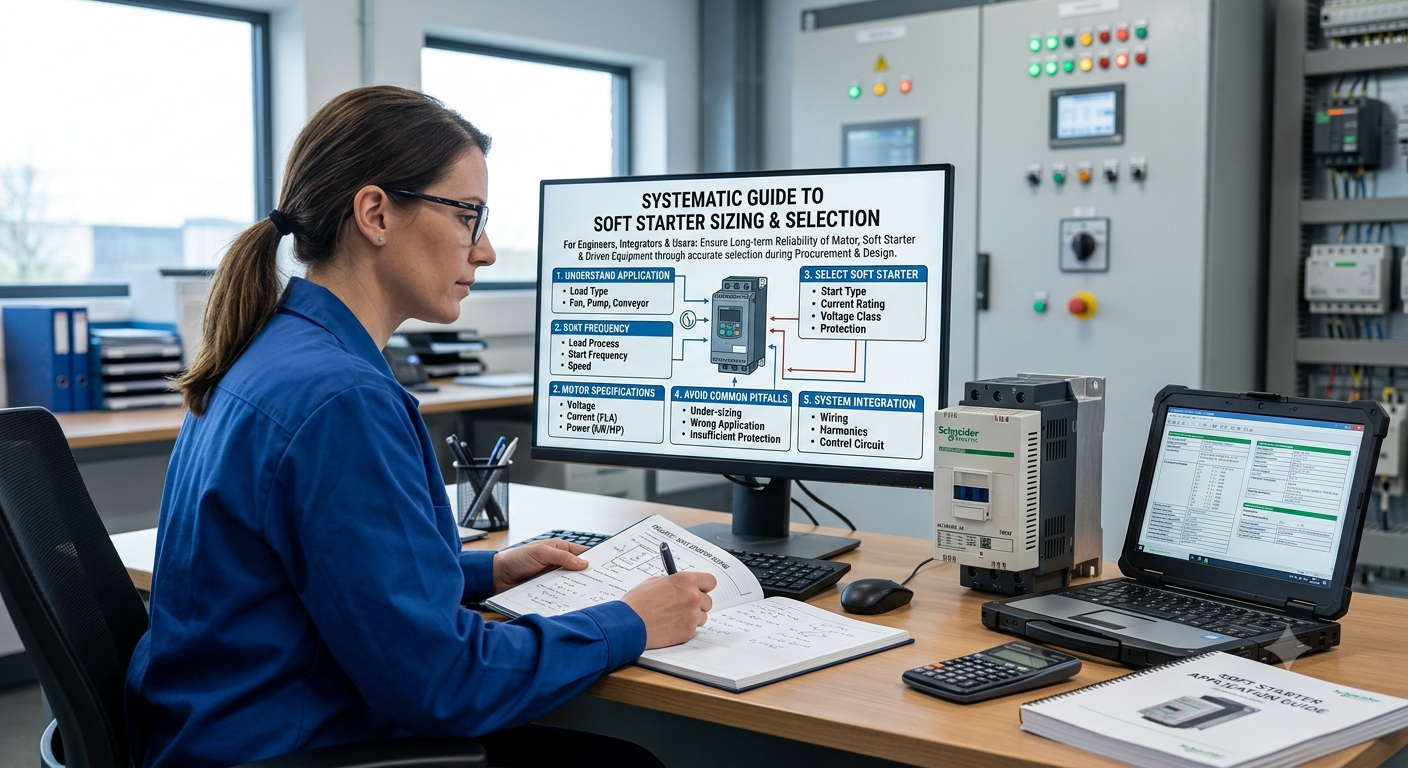
In the impression of many engineering personnel, configuring a soft starter for a motor seems to require only two parameters: motor power (kW/HP) and supply voltage. However, in actual engineering practice, a soft starter selected based solely on these two data points often results in starting difficulties, frequent tripping, component overheating, or even premature failure after being put into service. Truly scientific soft starter selection is a systematic engineering process that comprehensively considers motor parameters, load characteristics, starting conditions, environmental factors, and functional requirements.
This article will systematically outline the complete methodology for soft starter sizing and selection, helping engineers, equipment integrators, and end-users avoid common pitfalls during the procurement and design stages, and laying the foundation for long-term stable operation of the motor, soft starter, and driven equipment.
Step One: Collect Motor Nameplate and System Basic Data
The first step in selection is to accurately obtain the key parameters from the motor nameplate, as well as basic information about the power supply system. These data are the foundation for all subsequent calculations and judgments:
- Rated power (kW / HP) and rated voltage (V);
- Motor rated current / full load current (FLC);
- Supply frequency (50Hz / 60Hz) and number of phases;
- Motor service factor;
- Motor connection method (star Y / delta Δ), which affects the wiring scheme of the soft starter (in-line full voltage or inside-delta);
Supply system capacity and grid strength (whether voltage fluctuations or capacity limitations exist).
Note: The rated current of the soft starter must be based on the motor's actual full load current (FLC), and not roughly estimated only by the motor nameplate power, because motors from different manufacturers and with different efficiency classes may have different rated currents under the same power rating.
Step Two: Identify Load Type and Starting Torque Characteristics
Different types of loads have significantly different requirements for torque, acceleration time, and impact during the starting process, which is a critical factor in determining the success of soft starter selection.
Centrifugal pump loads: Starting current and torque requirements are relatively moderate, but starting too fast or too violently can easily cause water hammer effects, impacting pipes and valves. Therefore, more attention is paid to smooth starting and soft stop functions;
Fan loads: Especially high-inertia fans, which need to overcome large rotational inertia during starting, typically requiring longer acceleration times and higher starting torque;
Conveyor loads: Starting smoothness directly affects whether materials spill and whether conveyor belts slip, requiring focused control of the starting ramp time;
Crushers, pulverizers, mixers, and other heavy-duty equipment: High starting torque requirements, large starting current, often requiring soft starters with greater margins, and even evaluation of variable frequency drive (VFD) alternatives.
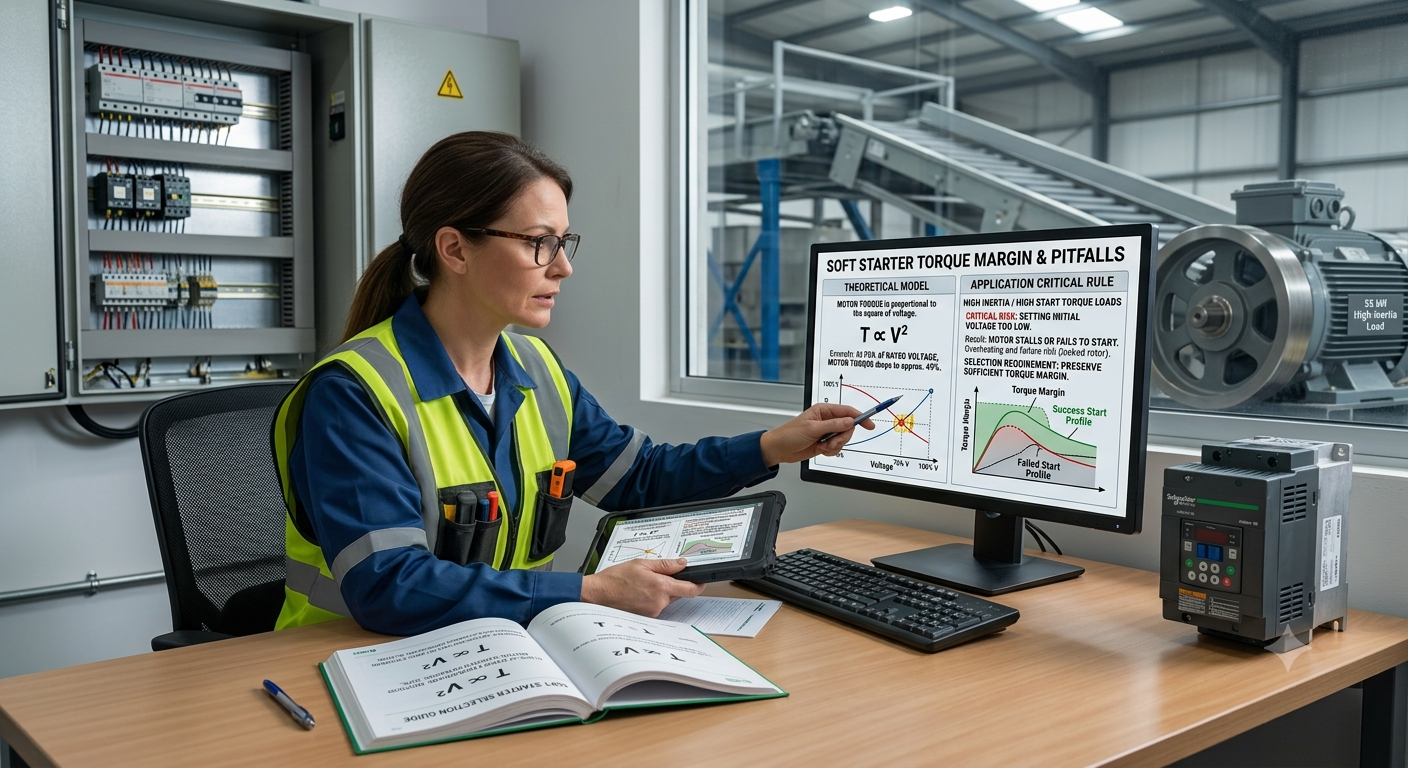
It is particularly important to note the physical relationship between voltage and torque: motor torque is approximately proportional to the square of the voltage (T ∝ V²). This means that when the soft starter reduces the starting voltage to 70% of the rated voltage, the motor output torque will drop to about 49%. Therefore, for loads with high inertia and high starting torque requirements, if the initial voltage is set too low, the motor is very likely to fail to start or experience prolonged locked-rotor overheating. Sufficient torque margin must be reserved during selection.
Step Three: Determine Starting Class
Internationally, the NEMA starting class system (Class 10 / 20 / 30) is commonly used to describe the capability of soft starters (and thermal overload protection) to accommodate starting time and starting current. The larger the starting class number, the longer the starting time the soft starter allows, and the greater the thermal stress the motor withstands during starting, requiring higher demands on the soft starter's heat dissipation and protection design.
| Starting Class |
Applicable Scenarios (Typical Applications) |
Characteristics |
| Class 10 |
Light-duty starting: fans, pumps, light/unloaded conveyors, light-duty mixers, etc. |
Short starting time (about 10 seconds to reach full speed), light load, moderate starting frequency |
| Class 20 |
Medium loads: most air compressors, hammer crushers, loaded mixers, etc. |
Longer starting time (about 20 seconds), motor must withstand longer starting stress |
| Class 30 |
Heavy-duty starting: shredders, crushers, high-inertia fans (running current often >85A) |
Longest starting time (about 30 seconds or more), highest requirements for motor thermal protection and soft starter capacity |
Accurately determining the appropriate starting class helps to properly set the thermal protection parameters (Overload Class) of the soft starter, avoiding nuisance tripping due to overly sensitive protection, or failure to effectively protect the motor windings due to overly relaxed protection.
Step Four: Select by Full Load Current and Reserve Safety Margin
The basic principle of soft starter selection is: soft starter rated current ≥ motor rated current (FLC). However, simply matching the current is not sufficient; a reasonable safety margin should also be reserved according to the load category to cope with grid voltage fluctuations, frequent starts and stops, environmental derating, and other actual operating conditions.
| Load Category |
Typical Equipment |
Recommended Rated Current Margin |
| Light load |
Fans, centrifugal pumps, unloaded conveyors |
Soft starter rated current ≥ 1.0~1.2 × motor rated current (FLC) |
| Medium load |
Conveyors, compressors, loaded mixers |
Soft starter rated current ≥ 1.2~1.5 × motor rated current (FLC) |
| Heavy load |
Crushers, pulverizers, high-inertia fans |
Soft starter rated current ≥ 1.5~2.5 × motor rated current (FLC); evaluate VFD solution if necessary |
Note: Never select a soft starter based only on an "exact match" to the motor rated current; always reserve a margin. For frequent start-stop or high-inertia applications, it is recommended to choose the next larger size to extend soft starter service life and improve system reliability.
Step Five: Environmental and Operating Condition Derating Factors
The rated current of a soft starter is usually given under standard environmental conditions (e.g., altitude below 1000m, ambient temperature 40°C). When actual operating conditions exceed the standard range, the soft starter must be derated accordingly, mainly considering the following aspects:
Altitude: The higher the altitude, the thinner the air, and the lower the heat dissipation capacity, requiring derating of the soft starter;
Ambient temperature: For every certain increase in the installation environment temperature, the allowable load current of the soft starter should be reduced according to the manufacturer's derating curves;
Starts per hour: The more frequent the starts and stops, the more obvious the heat accumulation in the soft starter's power devices; calculations should be made according to the manufacturer's start frequency - current derating table;
Cleanliness and humidity of the installation environment: In dusty, humid, or corrosive gas environments, products with corresponding enclosure protection ratings (IP ratings) should be selected, or cabinet isolation and heat dissipation measures should be taken.
Step Six: Function and Accessory Selection
In addition to capacity sizing, the functional configuration of the soft starter directly affects the system's operational performance and long-term reliability. It is recommended to select the following functions according to actual needs:
- Ramp start and initial voltage: For fine-tuning starting smoothness to suit different load characteristics;
- Current limit: To limit the peak starting current and protect the grid and distribution system;
- Soft stop: Suitable for applications sensitive to stopping impact, such as pumps, effectively suppressing water hammer effects;
Built-in bypass contactor: After the motor starts, it automatically switches to bypass operation, reducing heat generation in the soft starter's internal power devices and improving system efficiency. This is a recommended configuration for continuous operation;
Motor protection functions: Overload, phase loss, phase unbalance, locked rotor, etc., effectively extending motor life;
Communication functions: Such as RS-485/Modbus and other fieldbus interfaces, facilitating integration with PLC, DCS, and other automation systems for remote monitoring and fault diagnosis.
Experience tip: Properly configured protection and bypass functions often save maintenance costs and downtime losses far exceeding their own cost, and should not be omitted as "optional" items.
How to Choose Between Soft Starter and Variable Frequency Drive (VFD)
In some applications, both soft starters and VFDs can achieve smooth motor starting, but their functional positioning is fundamentally different: soft starters are for "start-stop control," while VFDs are for "full-range speed regulation." The following comparison can serve as a reference for selection decisions:
| Comparison Dimension |
Soft Starter |
VFD |
| Initial investment |
Relatively low |
Relatively high |
| Speed regulation capability |
Not available, only start-stop control |
Full-range stepless speed regulation |
| Starting torque |
Limited by the voltage-square relationship, relatively limited |
Can achieve high starting torque |
| Operational energy saving |
No significant energy saving effect at constant speed operation |
Variable speed operation can significantly save energy |
| System complexity |
Simple structure, easy commissioning and maintenance |
Relatively complex, requiring consideration of harmonics, heat dissipation, etc. |
| Applicable scenarios |
Start-stop control, limiting inrush current and mechanical stress |
Processes requiring variable speed operation or precise torque control |
In short, if the process only requires smooth start-stop, limiting inrush current and mechanical stress, a soft starter is a more economical, simpler, and more reliable choice. If the process requires continuous variable speed operation, precise torque control, or operational energy savings, a VFD solution should be prioritized.
Common Selection Misconceptions
Selecting only roughly by motor power (kW), ignoring the actual full load current (FLC);
Neglecting load type and starting torque characteristics, resulting in undersized selection for heavy-duty applications;
Failing to adequately calculate starts per hour, leading to thermal tripping of the soft starter in frequent start-stop applications;
Ignoring derating factors such as altitude and ambient temperature, operating under "substandard" conditions at high temperatures or high altitudes;
Not configuring a bypass contactor, causing long-term operation to intensify internal component heating and shorten service life;
Still reluctantly using a soft starter instead of a VFD for processes requiring continuous speed regulation, resulting in unsatisfactory energy savings and process performance.
Selection Example Analysis
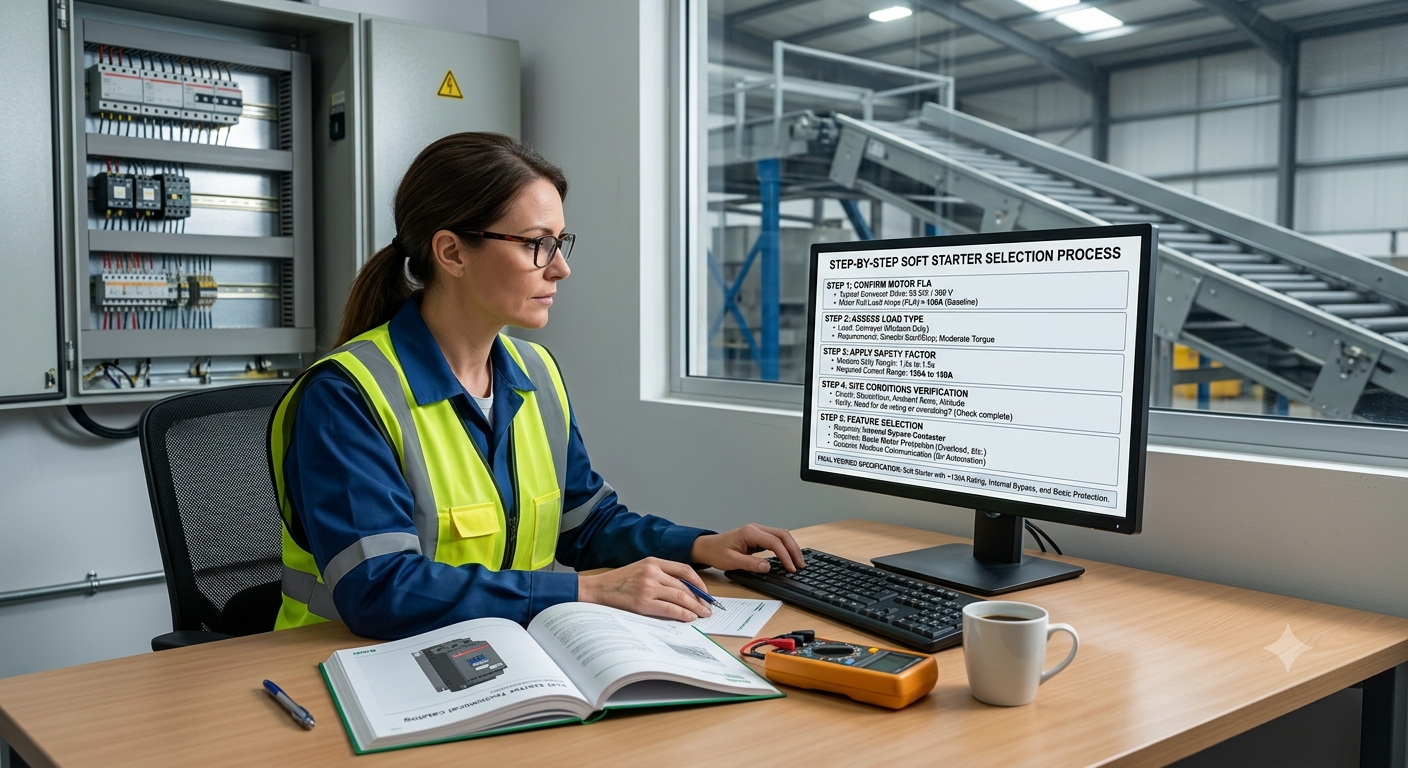
Taking a typical working condition as an example: A factory intends to configure a soft starter for a 55kW / 380V conveyor drive motor. The motor full load current is about 100A, belonging to a medium load (with relatively high starting smoothness requirements, but moderate starting torque demand).
Step 1: Confirm motor full load current FLC ≈ 100A;
Step 2: Determine the load type as "conveyor-type medium load," starting class can be considered as Class 10~20;
Step 3: Based on the medium-load margin factor of 1.2~1.5 times, the soft starter rated current should be selected in the range of 120A~150A;
Step 4: Combine the actual starts per hour on site, ambient temperature, and altitude conditions to verify whether further derating is required, and if necessary, upgrade to a larger size;
Step 5: Based on continuous operation requirements, it is recommended to select a built-in bypass contactor and basic motor protection functions. If the site needs to interface with an automation system, a Modbus communication module can be optionally added.
Through the above five-step calculation, the final selection is a soft starter model with a rated current of about 130A, equipped with a bypass contactor and basic protection functions, which can properly balance starting performance, operational economy, and long-term reliability.
Conclusion
Soft starter selection is not simply a matter of "looking up tables and matching parameters," but a systematic task that requires comprehensive consideration of motor parameters, load characteristics, starting conditions, environmental factors, and functional requirements. Only by fully evaluating all factors during the selection stage can the matching between the soft starter, motor, and driven equipment be ensured, thereby achieving a smoother starting process, lower maintenance costs, and longer equipment service life.
Zhejiang NENA Electric Co., Ltd. has long been focused on the research, development, and manufacturing of motor starting and control products. Based on customers' motor parameters, load conditions, and site environments, we can provide soft starter selection recommendations and customized solutions, helping customers achieve safer and more efficient motor starting control.



 English
 中文简体
中文简体 عربى
عربى




 浙公网安备33038202003754号